Open Access Policy for Images of Works of Art Presumed in the Public Domain
Last Updated: January three, 2020
From 1998 to 2019, the number of works in the public domain was stagnant.
Why? Well, thank you to Mickey Mouse.
In 1998, Steamboat Willie was less than x years from entering the public domain.
And Disney wasn't pleased.
Disney is ane of the loudest voices and pocketbooks fighting for longer copyrights.
And in 1998, their lobbying paid off. Because Congress passed a law adding twenty years to all copyright terms.
This new police force striking interruption on works entering the public domain.
In 1998, works first published in 1922 were released in the public domain.
But the intermission button meant that works first published in 1923 wouldn't exist released into the public domain until 2019.
So for 21 years, the number of works in the public domain was effectively the aforementioned.
Luckily for creatives, on January 1, 2019, we hit the play button again.
Equally of January 1, 2020, all works starting time published in 1924 are in the public domain.
And at present hundreds of thousands of new books, music, paintings, poems, films, and photographs are in the public domain.
Some of these include:
- George Gershwin'southRhapsody in Blue
- Eastward.Thou. Forester'due southA Passage to India
- Agatha Christie'sThe Man in the Brown Suit
- Thomas Mann'sThe Magic Mount
- Paul Klee'southAsiatic God,Carnival in the Mountains, andFlower Garden
And thanks to sites like Google, within a few days nosotros'll likely get access to digital copies of these works.
Meaning almost instantly you tin kickoff using, performing, adapting, and edifice upon them.
As of now, there'south no pending legislation that will hit the break push button over again.
So, this process should repeat each January 1st until 2073. (Considering the copyright term is tied to the year of publication, non the exact twenty-four hour period of first publication.)
After January 1, 2073, the process will go on, but will no longer be based on start publication. Instead, works will enter the public domain lxx years afterward the year the author died.
Why does it matter if work is in the public domain?
Say you lot desire to take Sherlock Holmes and use it in your own work.
If Sherlock Holmes is still protected by copyright, then you'll either need to:
- get permission to use it
- utilise it in a manner that equals fair use
But using it in a fashion that equals fair use severely restricts what y'all can practise with it.
If y'all wanted to create a parody, then you might be able to rely on fair utilize.
If y'all wanted to apply a very small part to illustrate a larger point, and so you might be able to rely on off-white apply.
If you are creating social commentary and wanted to apply a small piece, then you might be able to rely on fair use.
But what if you wanted to:
- write a modern adaptation set in 2019 London?
- write a futuristic version set in 3019 London?
- release the original text with your own illustrations?
- create a children'due south volume version?
- turn information technology into a play/movie?
- take the original and create an electronic or audiobook version?
If yous wanted to practise any of these things, and then you'll need to make sure that Sherlock Holmes is in the public domain. (Or get permission from the Sir Arthur Conan Doyle Estate.)
Works in the public domain are gratuitous for creatives to use, build on, transform, or perform.
What is the public domain?
The public domain contains creations eligible for copyright simply they aren't protected.
If something is in the public domain you can use, alter, accommodate, change, or build upon the original without asking permission.
Creations in the public domain are complimentary for creators to do as they please.
How does work enter the public domain?
At that place are 3 common ways that work enters into the public domain:
- copyright expires
- copyright never perfected
- work was never protected by copyright
Piece of work is in the public domain because the copyright has expired
The U.S. Constitution gives creators the exclusive correct to monetize their piece of work for a limited time.
Simply what qualifies as a "express time" has gotten longer and longer.
In 1790 when the first Copyright Act was passed this "limited time" was 14 years. And if the creator was still live at the end of those 14 years, he/she could renew the copyright for some other 14 years.
Pregnant the "limited time" was no more than 28 years.
For works created now, this "limited time" is much longer. Now information technology is 70 years after the death of the author. (Or for some works 95 years from first publication or 120 years from creation.)
Which at minimum is more than twice as long as the original cap.
Electric current copyright lengths
As I mentioned higher up, currently in that location's no one set copyright term.
In fact, thanks to changes over the years, there are four possible copyright terms for works protected past copyright.
These four options are:
- 95 years from first publication date
- 120 years from creation
- The longer of the creator'southward life plus lxx years OR Dec 31, 2047
- Life of the creator plus lxx years
What can no longer exist protected by copyright and is in the public domain
After the copyright term expires, work falls into the public domain.
If it was first published in the Us before 1925 it's no longer protected by copyright.
(Considering no matter which term applies, information technology will have expired.)
Pregnant everything first published before 1925 is now in the public domain.
Piece of work is in the public domain because the copyright was never perfected
Since 1989, copyright discover has been optional in the United states of america.
Before that, a copyright detect on the work was a requirement to make the copyright valid.
If a piece of work was first published before 1989 without discover, it is in the public domain because the copyright was never valid.
(Note: In that location was a pocket-sized window where creators could "prepare" this. To ready it, the piece of work had to be registered with the U.S. Copyright Function within five years.)
Work is in the public domain because it was never protected past copyright
Of form, many creations aren't eligible for copyright protection and aren't protected past copyright.
Works created by the U.Southward. Government (and information technology's employees) aren't protected past copyright.
So even if it'south eligible for copyright, if information technology's created by a government employee within his/her mean solar day-to-solar day duties it's not.
For example, Randy Bresnik has taken jaw-dropping photos of the World from the International Space Station.
But he's taking those photographs every bit role of his duties as an astronaut. And as an astronaut, he'southward a U.S. Government employee. Considering he'due south a government employee and taking photos is function of his job, the photos are automatically in the public domain.
What isn't in the public domain
Opposite to popular belief, doing any of these things does not put the work in the public domain:
- Putting work online
- Using a Creative Commons license (unless the rarely used PDM license is selected)
- Finding content online and not being able to trace it back to the original creator because it hasn't been properly credited/linked
Instead, you should work assume that information technology is protected by copyright unless y'all discover otherwise.
How to determine if something is in the public domain
As you glance at the chart below, you'll realize how difficult it can exist to decide if something is in the public domain.
Considering information technology'south difficult, over the last several years there have been high profile court cases that have "placed" work in the public domain. These include deciding that Happy Altogether to You, Sherlock Holmes, and Who'due south on First all had "fallen" into the public domain.
Of course, you don't want to exercise that. Then is there a procedure you lot tin use to determine if it'southward likely that the work is in the public domain?
Yeah!
How to employ the "Is it in the Public Domain" chart
You are going to start with the premise that the work is protected by copyright.
And you lot'll only alter your answer if yous can verify that information technology'south fallen into the public domain through your research.
For your research, you'll demand to respond five questions. Two of these questions are well-nigh the creator of the work. And 3 are about the work itself.
Questions about the creator
- Did a U.South. government employee inside the scope of his/her job create the work?
- Is the author alive or expressionless? If the author has died, what year did he/she die?
Did a U.S. government employee within the telescopic of his/her job create the work?
Equally discussed higher up, if a U.South. Government employee creates something as part of his/her job, and then it's automatically in the public domain.
Examples of this include:
- astronaut photographers
- WPA and FSA photographers (including photos taken by Walker Evans, Dorothea Lange, and Gordon Parks)
- laws
- government reports (similar a demography)
- federal court decisions
Is the author alive or dead? If the author has died, what twelvemonth did he/she dice?
If the work hasn't been published and the author died earlier 1949, then the work is at present in the public domain.
Questions nigh the piece of work
- Is the work published? If so, what was the year of first publication?
- Was the work first published with a copyright notice?
- Was the copyright renewed?
Is the work published? If so, what was the year of first publication?
Until 2073, works inbound the public domain volition be tied to the year of first publication.
So to decide if something is in the public domain you must larn the year of first publication. Anything first published in the United States prior to 1925 (on or earlier 12/31/1924) is in the public domain.
Was the piece of work first published with a copyright notice?
For all works first published before Feb 28, 1989, a copyright notice was required.
So to determine if something is in the public domain, you must outset learn the year of first publication. And then if it was published before 1989, larn if it was published with a copyright detect.
- If it wasn't and the work was published in or before 1977, then the work has fallen in the public domain.
- If information technology wasn't and the work was published between 1978 and 1989, then this could exist "stock-still". To "fix" it, the work had to be registered with the U.S. Copyright Office within v years of publication. If information technology wasn't registered, then the work has fallen into the public domain.
Was the copyright renewed?
Earlier 1978, the copyright system involved renewing your copyright. So there's a small window (from 1924 to 1963) where this "old" organisation still applies.
If a work was published betwixt 1924 and 1963 with a copyright observe and was registered, so information technology's still protected if the copyright was renewed. If information technology wasn't the work has fallen into the public domain.
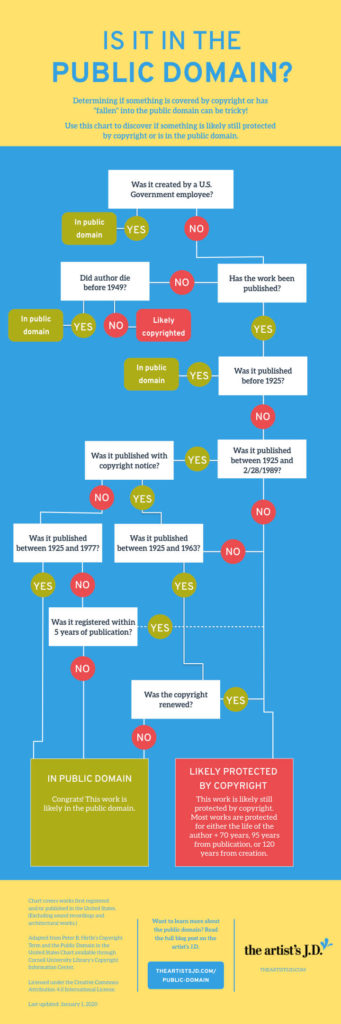
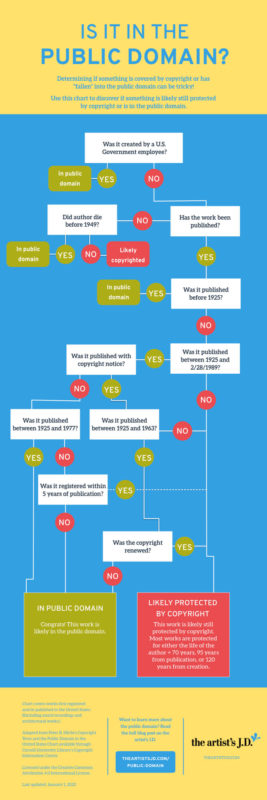
Is it in the public domain?
Catch a PDF copy of the "Is it in the public domain?" chart, then you can follow along to notice if the work you lot'd similar to utilize is in the public domain!
A couple of notes:
- Publication is the year of first publication
- This nautical chart is for works first published in the Us or works created by U.Southward. residents or people living in the U.s.a. at the time of creation.
- In that location are different rules for sound recordings and architectural drawings, so don't rely on the nautical chart in a higher place for those items.
- The copyright term runs through the end of the calendar yr, it doesn't elapse on the anniversary of first publication or the creator's death.
Let me know in the comments beneath if this chart helps you navigate what is and isn't in the public domain.

Hello! I'thou Kiff! I believe that you can have ease in the legalese of running your artistic business concern.
Each week, I send out an email to aid y'all confidently strengthen your business' legal foundation by sharing my experiences and knowledge.
Get tips from your friendly legal eagle…
Your privacy is important to us. Larn how we protect it hither.
Source: https://theartistsjd.com/public-domain/
0 Response to "Open Access Policy for Images of Works of Art Presumed in the Public Domain"
Post a Comment